

DRY LICORICE STICK & CRUSHED
Durvesh International supplies crushed licorice root and sticks (Glycyrrhiza glabra), dried and packed in 1 kg bags, from Pakistan to US importers, distributors, tea blenders and grocers. Request a quote, specification sheet and sample before you order, and get the lot documents your customs broker needs.Dry Licorice Stick & Crushed
Botanical / Scientific / Latin Name:
Glycyrrhiza glabra Linn
Arabic Name: Aruq as Soos
Why US buyers choose this licorice from Durvesh International
- Ready-to-use pieces. Sticks and crushed pieces steep, blend and measure more easily than long whole roots, so tea makers and grocers can use them without more cutting [CONFIRM: particle size range].
- Packed for shelves and for bulk. The 1 kg bag shows the product name in English, French and Arabic, which suits Middle Eastern and international grocery shelves. Bulk bag sizes are available on request [CONFIRM: bulk packing].
- Clear identity. Latin name (Glycyrrhiza glabra L.), Arabic name (Aruq as Soos), and trade names (licorice, liquorice, Asl al-Soos, mulethi) are all stated.
- Exporter-direct. You deal with the manufacturer and exporter in Karachi, not a chain of traders.
Grades and packaging formats
The product page photos show two 1 kg bag designs, one blue and one red, plus other bag and loose-product images. [CONFIRM: what each bag variant is, for example different cut grades or different brands.] Name each variant clearly on the page so buyers can order the right one. For export, bulk packing is [CONFIRM: packing type and weights, for example PP bags or cartons with an inner liner]. Private-label and custom-print packs are [CONFIRM: available or not, with MOQ].Uses and applications
Licorice root has a naturally sweet, anise-like taste, so buyers use it where flavor and aroma matter.- Herbal tea and infusion makers: crushed pieces for steeping or filling tea bags, or for blending with other botanicals. Durvesh also supplies herbal teas and related items in Herbs & Botanicals.
- Grocery and traditional-drink buyers: licorice root is the base of a traditional chilled drink in the Middle East and North Africa, and the Arabic name on the bag (Aruq as Soos) is how many of those buyers search for it.
- Food and beverage makers: flavoring for teas, desserts, and sweet and savory dishes, and a base for syrups and flavor systems.
- Botanical and supplement processors: a raw material for milling and further processing, subject to your own formulation, labeling and claims review.
- Traditional markets: licorice is also used in traditional Chinese Kampo and Ayurvedic practice. Durvesh International supplies the dried root as an ingredient and makes no health claims about it.
Sourcing and quality process
[CONFIRM: describe the real steps, for example where the roots are collected, how they are dried, how they are crushed and sifted, and how each lot is coded.] Name the steps the factory actually performs. Do not publish a step that is not performed. Durvesh International has been a licorice and botanical exporter since [CONFIRM: year] from Karachi, Pakistan, with [CONFIRM: factory or warehouse location and size].Testing, certifications and documents
US buyers usually ask for the same short list on dried botanicals: identity, moisture, heavy metals, pesticide residues and microbial indicators. Test coverage for this item is [CONFIRM: in-house or third-party lab name and tests performed, with report dates]. Certifications held by Durvesh International: [CONFIRM: list each one with issuing body, certificate number and expiry, for example ISO 22000, ISO 9001, GMP, HACCP, Halal]. FDA food facility registration: [CONFIRM: registration status and number, if any]. Ask for the certificate of analysis for the exact lot before you order, and set your acceptance limits in the purchase specification.Wholesale terms and minimum order
- Minimum order quantity: [CONFIRM: MOQ and unit]
- Samples: [CONFIRM: sample size, free or paid, courier terms]
- Lead time: [CONFIRM: production and shipping lead time]
- Payment terms: [CONFIRM: for example T/T, L/C]
- Pricing: Price on request. Send quantity, packing and destination port for a written quote.
Exporting dried licorice to the USA
Dried botanicals normally move by sea freight. Durvesh International ships from Pakistan on [CONFIRM: FOB, CFR or CIF terms] from [CONFIRM: port of loading, usually Karachi], and the importer or its customs broker files the US entry. For food use, US importers need to meet FDA requirements, including prior notice of imported food and a foreign food facility registration where applicable. Durvesh can supply the supporting documents once confirmed [CONFIRM: document support]. Duties depend on the product’s tariff classification and current trade policy, so confirm the rate with your customs broker before ordering. Retail bags need US-compliant labels. If you sell the 1 kg bag as it is, check the label with your compliance advisor first: the current bag is labeled for general export, and US labeling rules for ingredients, net weight and the importer’s name may require changes [CONFIRM: US labeling support]. Keep your paperwork consistent. State the intended use (food or tea ingredient, or dietary supplement ingredient) the same way on the invoice, your entry and your label. Mismatches between these are a common cause of shipment holds.Safety and labeling note for finished-product makers
Licorice root and its derivatives are listed as generally recognized as safe for specified food uses under 21 CFR 184.1408, within limits. Licorice contains glycyrrhizin, and eating large amounts over time can raise blood pressure and lower potassium. If you make a finished product, you are responsible for formulation, labeling, serving size and any claims, so review them with a qualified food-law advisor.Choosing the right licorice form
| Form | What it is | Best for | Buyer note |
| Whole long sticks | Whole dried root pieces | Steeping, own cutting or milling | Most flexible; see our dried licorice selected long stick |
| Sticks and crushed (this product) | Dried root in short sticks and crushed pieces | Steeping, tea blending, grocery packs | Ready to use; confirm cut size |
| Long slices | Root cut lengthwise or in slices | Decoction and infusion | See our licorice long slice |
| Powder | Finely milled root | Capsules, tablets, direct mixing | Check mesh size and microbial limits; see licorice roots powder |
Why Durvesh International
- A manufacturer and exporter of herbs, botanicals, spices, Himalayan pink salt, herbal teas and dry fruits, so licorice can ship with other items in one order [CONFIRM: mixed containers possible].
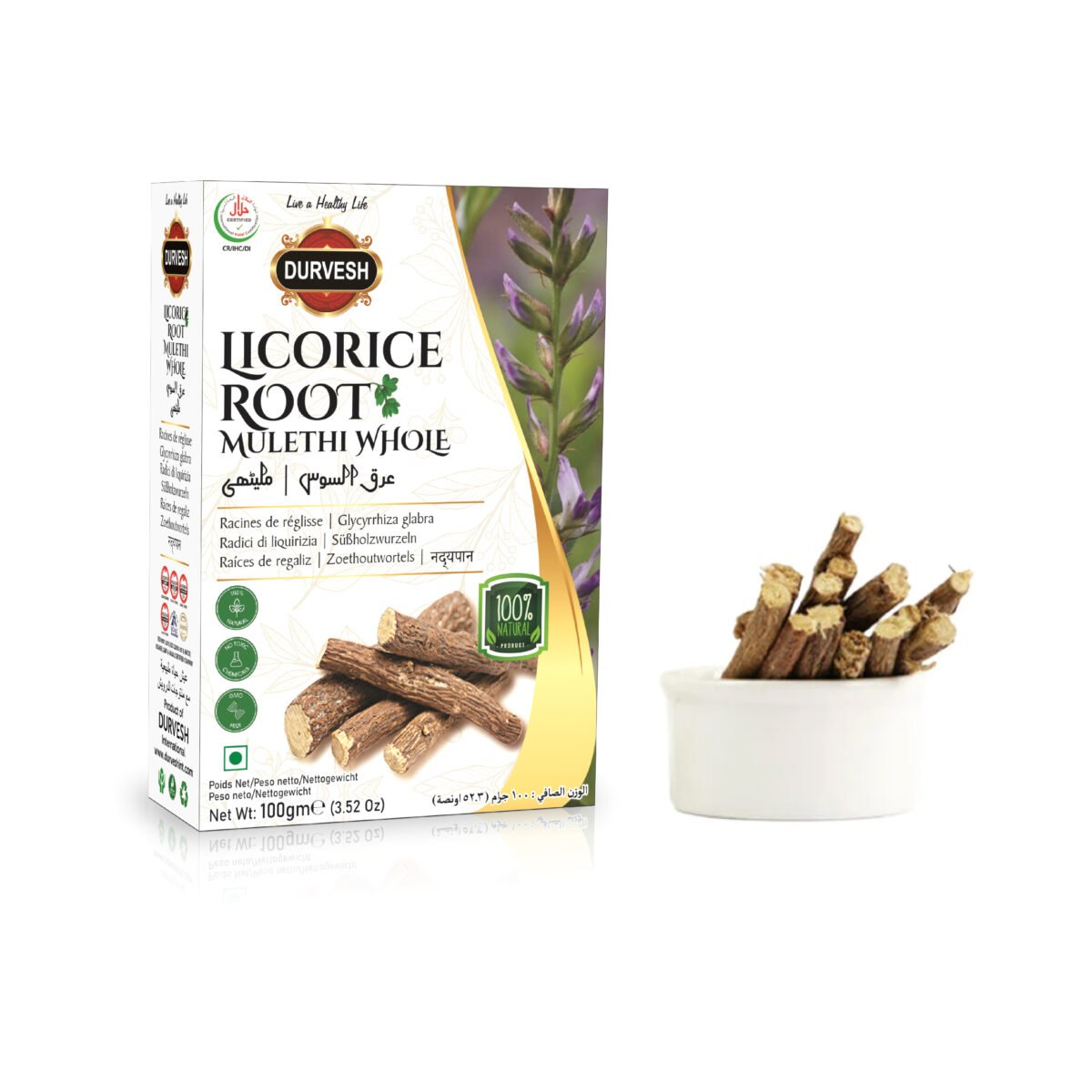
- A full licorice range (sticks, slices, crushed, powder and 100 g packs), so one supplier covers several forms.
- A named, contactable company in Karachi, Pakistan, with a published phone and sales email.
- A buyer-first inquiry process: tell us your use, volume and port, and the sales team replies with specs, documents and a quote.
FAQs
What is crushed licorice root?
Crushed licorice root is dried Glycyrrhiza glabra root broken into small pieces instead of left as long sticks. The pieces keep the root’s natural sweetness and anise-like aroma and are easier to measure, steep and blend. Buyers use them for herbal tea, traditional drinks, syrups and flavoring, or mill them further into powder.What is in the Dry Licorice Stick & Crushed product?
This product is dried licorice root supplied as sticks and crushed pieces [CONFIRM: ratio and particle size range]. It is a single-ingredient botanical [CONFIRM: no additives]. If you need whole long sticks, powder or slices instead, Durvesh International also lists those forms in its licorice range, and the sales team can advise on the right cut for your process.What is the difference between crushed, cut and sifted, and powder?
Crushed pieces are broken roots of mixed sizes. Cut and sifted licorice is cut to a set size and screened to remove oversized and fine material. Powder is milled fine. For tea bags and blends, cut size matters most, so ask for a size range in millimeters and the allowed share of fines before you order.What pack sizes are available?
The product photos show a 1 kg bag in two designs [CONFIRM: all retail pack sizes]. Bulk packing for importers is [CONFIRM: bag or carton type and weights]. Tell the sales team the pack size you need, whether retail bags for shelves or bulk bags for blending, and they will confirm what is possible and the minimum order.What is the minimum order quantity?
The minimum order quantity for Dry Licorice Stick & Crushed is [CONFIRM: MOQ and unit]. Durvesh International works with importers, distributors, and private-label brands, and can discuss sample quantities before a full order. Send your quantity, packing preference, and destination port through the inquiry form, and the sales team will reply with a quote.Is licorice root safe to use in food and tea in the US?
In the US, licorice root and its derivatives are listed as generally recognized as safe for specified food uses under 21 CFR 184.1408, within limits. Licorice contains glycyrrhizin, and eating large amounts over time can raise blood pressure and lower potassium. Finished-product makers are responsible for formulation, labeling, and claims, and should confirm their intended use with a qualified food-law advisor.What documents can I request with a shipment?
Importers commonly ask for a certificate of analysis, specification sheet, certificate of origin, and phytosanitary certificate where required. Durvesh International can supply [CONFIRM: document list] on request. Tell the sales team your intended use, whether food, tea, or dietary supplement ingredient, so the paperwork and descriptions stay consistent with your FDA and customs entry.How should crushed licorice root be stored?
Keep crushed licorice root in sealed, moisture-barrier packaging in a cool, dry place away from light. Smaller pieces take up moisture faster than whole sticks, and damp storage can lead to mold and flavor loss. Check the lot’s moisture result on the certificate of analysis and the shelf life stated by Durvesh International [CONFIRM: shelf life] before you plan inventory.Where does the licorice come from, and what is the botanical name?
The botanical name is Glycyrrhiza glabra L., also sold as liquorice, réglisse, mulethi, Asl al-Soos, and in Arabic as Aruq as Soos. Durvesh International exports from Pakistan. The harvest region and country of origin shown on shipping documents are [CONFIRM: origin and harvest region]. Importers should ask for origin documentation, because traceability matters for US customs review and buyer audits.Can I order private-label or custom-print packs?
Private-label and custom-print packing for licorice is [CONFIRM: available or not, with MOQ]. If offered, buyers normally set the pack size, label design, and ingredient statement, and the brand owner is responsible for US label compliance. Share your target format and expected annual volume in the inquiry so the team can confirm what is possible.Is the licorice tested for heavy metals and microbes?
Heavy metals, pesticide residues, and microbial indicators are the tests US buyers most often ask for on dried botanicals. Test coverage for this product is [CONFIRM: lab name and tests performed]. Ask for the latest certificate of analysis for the lot you are buying, and set your own acceptance limits in the purchase specification.DRY LICORICE STICK & CRUSHED