
Importing herbal products from Pakistan to the USA is legal and profitable—but only if you follow FDA and customs rules. This guide walks you through every step: regulatory requirements, HS code classification, supplier vetting, customs clearance, and quality assurance. By the end, you’ll know exactly how to source from Pakistan, clear customs, and launch your herbal product business in the American market.
Can You Actually Import Herbs from Pakistan to the USA? (Yes, But With Rules)
Yes—herbal product imports from Pakistan are legal and common. The U.S. imports over 400 million pounds of herbs annually, with Pakistan among the top five suppliers globally. But “legal” doesn’t mean uncomplicated. FDA oversees safety, CBP (U.S. Customs & Border Protection) monitors entry, and USDA enforces agricultural rules. Each layer adds requirements.
Why Pakistan? Cost is the obvious reason. Pakistani herbal suppliers offer botanicals at 40–60% lower prices than domestic producers, and quality is competitive. Punjab and Sindh provinces grow turmeric, ginger, ashwagandha, hibiscus, and dozens of medicinal herbs in climates that produce potent, high-yield crops. Pakistani exporters are experienced with U.S. regulations, speak English, and often ship direct.
What counts as “herbal products” under U.S. law? The category is broader than you might think:
- Culinary herbs & teas — dried mint, chamomile, herbal tea blends (minimal FDA oversight)
- Dietary supplements — ashwagandha powder, turmeric extract, herb capsules (FDA registration required; no pre-market approval)
- Medicinal herbs with health claims — “cough relief” or “immune support” products (requires drug approval; most importers avoid this)
Each pathway has different compliance costs and timelines. We’ll cover all three below.
Key players in the import process:
- FDA (Food & Drug Administration) — Approves/registers products, monitors safety, can detain shipments
- CBP (U.S. Customs & Border Protection) — Clears goods at ports, collects tariffs, may inspect cargo
- USDA (U.S. Department of Agriculture) — Enforces phytosanitary rules (some herbs require origin certificates)
- EPA (Environmental Protection Agency) — Sets pesticide tolerance levels for imported botanicals
Understanding these players’ roles is your first step to a smooth import.
FDA Requirements for Herbal Imports from Pakistan
This section answers the question most importers ask first: “Does the FDA approve my herbs before I import them?” The answer is nuanced.
Three FDA Pathways (Choose One)
Pathway 1: No Pre-Market Approval Needed Culinary herbs and herbal teas fall into this category. If you’re importing dried mint, chamomile, or a blended tea—with no health or disease claims on the label—FDA doesn’t require pre-approval. You still must:
- Source from a supplier with FDA facility registration (mandatory for all food manufacturers)
- Ensure the product passes CBP inspection (no pesticide residue, contamination, or undeclared additives)
- Comply with FDA labeling rules (ingredient lists, allergen warnings, no health claims)
Timeline: Fast. Customs clearance usually takes 5–10 business days.
Pathway 2: FDA Registration Required (Dietary Supplements) Most herbal supplements—ashwagandha capsules, turmeric powder sold as a supplement, herbal extracts—fall here. These products are governed by the Dietary Supplement Health and Education Act (DSHEA).
What you must do:
- Your supplier must hold FDA facility registration (a searchable database exists at fda.gov)
- You must register your herbal import business with FDA as a facility (free; takes ~15 minutes online)
- Your product must comply with Current Good Manufacturing Practice (CGMP) standards
- You may make structure-function claims (“supports healthy digestion”) but not disease claims (“treats IBS”)
Cost: Registration is free, but compliance adds overhead (testing, documentation, audits).
Timeline: Slightly longer than Pathway 1. Expect 10–15 business days for customs + potential FDA facility inspection.
Pathway 3: Drug Approval Required (Medicinal Claims) If your herbal product claims to treat, prevent, diagnose, or cure a disease (“cough relief,” “cold fighter,” “diabetes support”), FDA classifies it as a drug—not a supplement. This requires full pre-market approval, which costs 100,000–1M+ and takes 2–5 years.
Bottom line: Most importers avoid this pathway. Stick to structure-function claims (“supports energy”) or general wellness language.
FDA Import Alert & Automatic Detention List
Some herbal products and suppliers face automatic detention at U.S. ports. If your shipment matches certain criteria, CBP holds it without needing FDA approval. This is one of the biggest surprises for new importers.
Reasons for automatic detention:
- Pesticide residues exceeding EPA tolerance levels
- Lead or heavy metal contamination above FDA action levels
- Undeclared additives or prohibited ingredients
- Ephedra (banned entirely since 2004)
- Kava kava (restricted; high hepatotoxicity risk)
- Specific supplier history (if a Pakistan exporter has had prior violations)
Pakistan-specific context: Some Pakistani herbal suppliers—especially smaller, unregistered operations—have shipped products with lead contamination, inadequate testing, or mislabeling. This is why supplier vetting is critical (covered below).
How to check: The FDA maintains an active Import Alert 66-40 (detentions for herbal products). You and your customs broker can search this database before importing.
If detention happens: Your shipment is held pending testing, which adds 2–4 weeks and costs 500–2,000 in testing fees. If it passes, you’re clear. If it fails, the shipment is destroyed or returned to Pakistan, and you lose the product cost entirely.
Good Manufacturing Practice (GMP) & Facility Registration
All herbal suppliers shipping to the USA must operate under Current Good Manufacturing Practice (CGMP) standards. This means:
- Facility registration: FDA must have your supplier’s facility on file
- Quality control: Written procedures for testing, handling, and documentation
- Traceability: Records showing where ingredients came from, who tested them, and results
- Foreign Supplier Verification Program (FSVP): If you import food/supplements, you must verify your supplier’s compliance
What to ask your Pakistani supplier:
- “What is your FDA facility registration number?” (Should be findable in FDA’s public database)
- “Do you hold ISO 22000 or FSSC 22000 certification?” (International food safety standard; common in Pakistan)
- “Can you provide Certificate of Analysis (CoA) for your standard products?” (Proof of third-party testing)
- “Have you supplied U.S. importers before? Can you provide references?”
If a supplier can’t answer these clearly, move on. Vetting now prevents detention later.
HS Codes, Tariffs & Customs Clearance
Customs classification sounds dry—but it determines your tariff rate and entry timeline. Get it wrong, and CBP delays your shipment or applies the wrong tariff.
HS Code Classification: Why It Matters
The Harmonized System (HS) code is a 10-digit global classification system. For herbal products, most fall into two categories:
HS 1211 — Dried Medicinal Herbs Covers dried botanicals, crushed or powdered herbs, and medicinal plant material. Examples: turmeric powder, dried ashwagandha root, ginger chips.
- Tariff rate: 0% (free entry for most countries, including Pakistan)
- Duty impact: None—major advantage for importers
HS 0910 Spices & Herbal Seasonings Covers herbs used primarily as seasonings (not medicinal). Examples: dried oregano, thyme, dill.
- Tariff rate: 3–4% (depending on specific sub-code)
- Duty impact: Moderate; adds ~3–4% to landed cost
HS 2106 Food Preparations (Blended Supplements) Covers prepared herbal mixes, supplement blends, and herbal powders combined with other ingredients.
- Tariff rate: 5–7% (varies)
- Duty impact: Moderate to significant
How to know your code before importing? Work with your customs broker. They’ll classify the product based on composition and intended use. Misclassification can trigger CBP audits, so accuracy matters.
Import Duties on Pakistani Herbs: Cost Reality
Good news: Most herbal imports from Pakistan face 0% tariff (HS 1211 classification). This is why Pakistan is such a cost-effective source.
Current tariff rates (as of 2026):
- HS 1211 (medicinal herbs): 0% — Free entry
- HS 0910 (culinary spices/herbs): 3–4%
- HS 2106 (supplement blends): 5–7%
- Anti-dumping duties: None currently active on Pakistani herbs
Real cost example: 100 kg of turmeric powder from Pakistan
| Cost Component | Amount |
| Product cost (at Pakistan supplier) | $400 |
| Supplier handling & packaging | $50 |
| Ocean freight (LCL to USA port) | $300 |
| Insurance (0.5% of value) | $30 |
| Import tariff (HS 1211 @ 0%) | $0 |
| Customs broker fee | $150 |
| Testing (heavy metals, pesticides) | $500 |
| Port drayage & domestic delivery | $200 |
| TOTAL LANDED COST | $1,630 |
| Cost per kilogram | $16.30 |
This assumes sea freight (cheaper than air). If you use air freight, double the freight cost. Smaller shipments (under 500 kg) see higher per-unit costs due to fixed broker fees.
Customs Broker & Entry Process
Should you hire a customs broker? Most importers do, especially on their first shipments. Here’s why:
A customs broker is a licensed professional who files entry documents with CBP, navigates tariff classification, and manages the clearance process. They cost 100–300 per shipment, but they save you time, mistakes, and potential delays.
What the broker does:
- Reviews shipment documentation (invoice, packing list, CoA, HS code)
- Files CBP Entry/Immediate Delivery (Form 3461) within 5 days of arrival
- Arranges payment of tariffs & fees
- Coordinates any CBP/FDA exams
- Arranges port drayage and domestic delivery
How to find a broker: Search “[Your Port Name] customs broker” (e.g., “Los Angeles customs broker”). Most major ports have dozens. Interview 2–3, compare fees, and check references.
Entry timeline (typical):
- Day 1–2: Shipment arrives; broker receives notice
- Day 2–3: Broker files Entry document with CBP
- Day 3–7: CBP may request exam (random, ~10–20% of shipments); FDA may trigger inspection (rare, ~5%)
- Day 7–10: Exam completed (if triggered) or waived; customs duty paid
- Day 10–14: Release from port; arrange drayage to your warehouse
If no exam is requested, clearance is even faster (5–7 days).
Finding & Vetting Pakistani Herbal Suppliers
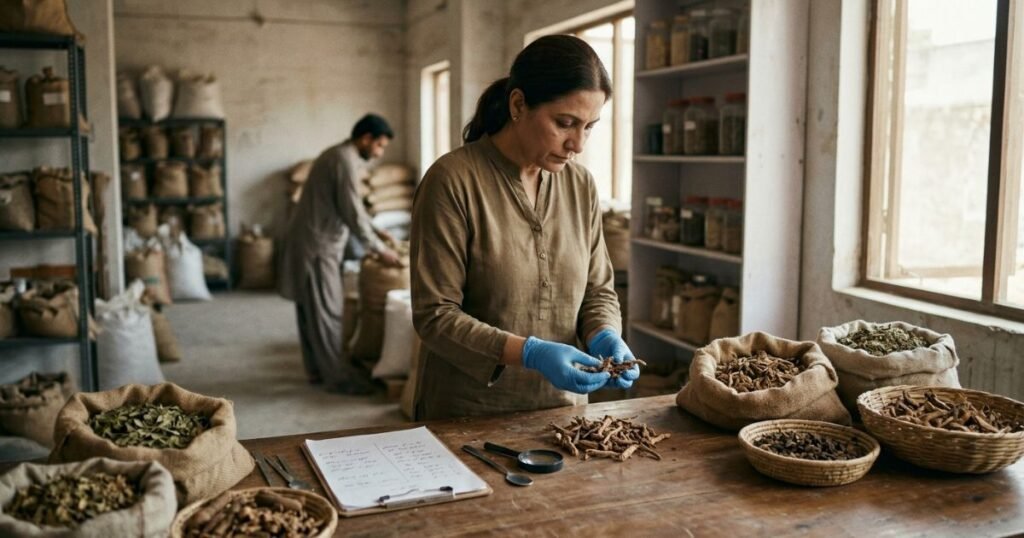
This is where most importers either succeed or fail. A good supplier delivers quality products on time; a bad one ships contaminated herbs, misses HS code requirements, or disappears mid-order. Vetting is non-negotiable.
Where to Find Suppliers
Trade Databases & Platforms:
- Zauba (zauba.com) — Export/import database; search “herbal medicine Pakistan export” to see historical shipments and supplier names
- Alibaba & GlobalSources — Supplier directories; filter by “Pakistan,” verify badge status and customer reviews
- Pakistan Chamber of Commerce & Industry (PCCI) — Official directory; members have been vetted for legitimacy
- Direct Google search — “Herbal exporters Pakistan,” “medicinal herbs manufacturers Punjab,” etc.
- Trade shows — Annual herbal & spice expos in Karachi, Lahore (many host virtual tracks)
Important: Don’t rely on a single source. Cross-reference suppliers across 2–3 platforms to verify legitimacy.
Vetting Checklist for Pakistan Exporters
Use this original supplier vetting checklist to evaluate any potential partner. Score each supplier 0–3 (0 = fail, 3 = excellent) and aim for a total of 20+/27 before placing an order.
| Question | Score (0–3) | Notes |
| Company Legitimacy | ||
| Company registered in Pakistan (verify with SECP)? | ||
| Years in business (aim for 5+)? | ||
| Website, contact info, physical address (verifiable)? | ||
| FDA & Export Compliance | ||
| FDA facility registration number visible/verifiable? | ||
| ISO 22000 or FSSC 22000 certification held? | ||
| Export to the USA before (ask for 2+ references)? | ||
| Quality & Documentation | ||
| Provides Certificate of Analysis (CoA) for standard products? | ||
| CoA includes heavy metals, pesticides, microbial testing? | ||
| Willing to undergo a third-party audit? | ||
| Communication & Terms | ||
| Responsive email; speaks English fluently? | ||
| Clear on MOQ (minimum order quantity) & lead time? | ||
| Willing to negotiate payment terms (90–120 days)? | ||
| Sample available before bulk order? | ||
| Red Flags | ||
| No prior USA export history? | (Score 0 if no history; risky) | |
| Pressures you to skip testing or CoA? | (Score 0; automatic fail) | |
| Prices significantly lower than market (suspicious dumping)? | (Score 0; quality concern) | |
| Reluctant to disclose facility details? | (Score 0; hide regulatory issue likely) |
Scoring:
- 24–27: Excellent partner; proceed confidently
- 18–23: Good; manageable risk
- 15–17: Moderate risk; request references & audit
- Below 15: High risk; find another supplier
Red Flags & How to Spot Them
1. No Certificate of Analysis If a supplier says “we don’t test our products” or “testing is optional,” stop. U.S. law requires testing for food safety. No CoA = no verification that the product is safe.
2. Unrealistic Pricing If turmeric is quoted at $2/kg when the market rate is 4–6/kg, something’s wrong. Dumping (selling below cost) often masks quality issues or adulteration.
3. No Prior USA Exports First-time exporters often don’t understand FDA rules or customs documentation. Not impossible, but higher risk. Prefer suppliers with 5+ successful USA shipments.
4. Reluctance to Share Facility Details If a supplier won’t disclose their FDA facility registration number or location, they may not have legitimate registration. This is a dealbreaker.
5. Pressure to Rush or Skip Steps Legitimate suppliers understand compliance. If they pressure you to skip testing, use informal payment, or hide shipment details, move on.
Sample Supplier Vetting Email Template (Original)
Subject: Inquiry: Herbal Product Import USA Market Quality & Compliance Questions
Dear [Supplier Name],
I’m interested in importing herbal products from Pakistan to the United States. Before proceeding, I’d like to verify your capability and compliance. Please provide answers to the following:
- Company & Experience
- What is your company’s full legal name and registration number (SECP)?
- How many years have you been exporting herbal products?
- Have you exported to the USA before? If yes, can you provide 2–3 customer references?
- FDA & Regulatory Compliance
- What is your FDA facility registration number? (Should be searchable at fda.gov)
- Do you hold ISO 22000 or FSSC 22000 certification? Please provide a certificate copy.
- Do you have a Quality Assurance (QA) manager who can discuss GMP compliance?
- Product Testing & Documentation
- For your standard herbal products, do you provide Certificate of Analysis (CoA)?
- What parameters does your CoA cover? (e.g., heavy metals, pesticides, microbial, identity/purity)
- Do you use a third-party testing lab, and which lab?
- Terms & Logistics
- What is your minimum order quantity (MOQ) for bulk herbs?
- What is your typical lead time from order to shipment?
- Do you offer samples before bulk orders?
- What payment terms can you offer? (T/T, L/C, etc.)
- Specific Product Questions
- [Specify product: e.g., “Do you supply organic ashwagandha powder?”]
- What is the HS code classification you use for this product?
- Pricing (per kg or per ton)?
Please provide detailed responses. I’m evaluating several suppliers and will select based on compliance, quality, and reliability.
Best regards, [Your Name]
Once you receive responses, cross-check the FDA registration number at fda.gov/FURLS (FDA’s online registration database). If the supplier’s number doesn’t exist or is inactive, do not proceed.
Quality Assurance & Testing Requirements
U.S. consumers expect herbal products to be safe, pure, and accurately labeled. Quality control is non-negotiable—and it’s your legal liability if something goes wrong.
What Testing Do Imported Herbs Need?
Heavy Metals Testing Herbs can absorb lead, cadmium, mercury, and arsenic from soil. FDA has established action levels (safe limits):
- Lead: 0.5 ppm (parts per million) for most herbs
- Cadmium: 0.3 ppm
- Mercury: 0.1 ppm
- Arsenic: 0.1 ppm (inorganic arsenic)
Many Pakistani herbs historically had lead issues due to soil contamination in certain regions. This is why testing is critical.
Pesticide Residues EPA sets tolerances for pesticide residues on food/herbs. Common residues tested:
- Organophosphates (chlorpyrifos, parathion)
- Pyrethroids
- Neonicotinoids
Testing typically runs 300+ pesticide residues. Labs follow EPA Method 8081B or similar.
Microbial Contamination FDA requires herbal products to be free of pathogenic bacteria. Testing covers:
- E. coli (fecal indicator) — Must be absent
- Salmonella — Must be absent
- Staphylococcus aureus — Limit: <100 CFU/g
- Total aerobic plate count — Limit: <100,000 CFU/g
- Mold/yeast — Limits vary by product
Identity & Purity Testing Confirms the herb is what you say it is (not adulterated or substituted):
- HPLC (High-Performance Liquid Chromatography) — Verifies active compounds (e.g., curcumin % in turmeric)
- DNA barcoding — Confirms botanical species (prevents fraud/substitution)
- Visual inspection — Checks for foreign matter, discoloration, odor
Where & When to Test
Before Import (Supplier Provides CoA): Request Certificate of Analysis from your supplier showing testing by a reputable lab. This costs you nothing (supplier bears cost) and saves time.
Best scenario: Supplier uses a CLIA-certified or ISO 17025-accredited lab in Pakistan or internationally (e.g., SGS, Eurofins).
After Import (USA Testing): If you want domestic verification or suspect issues, hire a U.S.-based lab. Types:
- Commercial testing labs — Service small businesses; 300–1,000 per test battery
- Contract labs — Specialize in dietary supplements; often faster, more detailed
- University labs — Some state universities offer testing; less expensive
Timeline: 10–21 days typical. Rush services (3–5 days) cost 2–3x more.
Cost breakdown (typical 2026 rates):
- Heavy metals panel: 200–400
- Pesticide residues (300+ compounds): 400–800
- Microbial testing: 150–300
- Identity/purity (HPLC): 200–500
- Total batch testing: 950–2,000
For bulk imports (500+ kg), cost per kg drops significantly. Budget $1–2/kg for testing.
Pakistan-Specific Quality Concerns
Lead Contamination Risk Certain regions of Punjab and Sindh have naturally high soil lead levels (mining legacy, industrial contamination). Herbs grown in these areas can accumulate lead. This is the single biggest import risk from Pakistan.
Mitigation:
- Ask your supplier: “Which region does your herb grow in?”
- Request CoA showing lead levels <0.3 ppm (well below FDA limit of 0.5 ppm)
- If CoA shows lead >0.3 ppm, negotiate a price discount or find another supplier
- Always require testing; don’t assume supplier’s word
Pesticide Residues Pakistani agriculture uses pesticides (some older, off-patent products banned in the U.S.). Residues can exceed EPA tolerances if farmers used recent applications.
Mitigation:
- Ask the supplier: “How long ago were pesticides last applied?”
- Verify CoA includes EPA-monitored pesticides (not just a few)
- Request “clean” or “low-residue” certification if available
Adulteration & Substitution Fraud is rare but possible: cheaper herbs mixed with target herb, or wrong species entirely (e.g., Indian ashwagandha substituted with cheaper Withania).
Mitigation:
- Use a supplier with years of USA export history (repeated shipments = less incentive to cheat)
- Request identity testing (DNA barcoding or HPLC for known active compounds)
- Order sample before bulk order; test the sample yourself
Special Cases Ayurvedic, Traditional & Restricted Herbs
Not all herbal products face the same rules. Some have stricter FDA oversight; others are outright banned.
Ayurvedic Products
What are they? Traditional Indian herbal formulas, often combining 3–10 botanicals. Popular examples: Triphala, Ashwagandha powder, Brahmi, Neem.
FDA rules:
- Ayurvedic herbs (if labeled as supplements, not medicines) can be imported—but with stricter metal limits for some products
- Heavy metal limits for Ayurvedic herbs: Some FDA guidance suggests tighter limits (lead <0.1 ppm) due to historical adulteration concerns
- Banned Ayurvedic ingredients: Aristolochic acid (nephrotoxic) is banned; products containing this will be detained
- Unpermitted additives: Mercury (ras) and lead (naga) were traditional ingredients; modern FDA does not allow these
Import strategy:
- Choose suppliers specializing in Ayurvedic export (they understand FDA rules)
- Verify no banned ingredients (aristolochic acid, mercury, lead additions)
- Request heavy metal testing emphasizing lead <0.1 ppm
- Expect 10–15% premium over non-Ayurvedic herbs due to stricter compliance
Restricted Herbal Products (FDA Bans)
Ephedra (banned since 2004) Ephedra-containing supplements (e.g., ma huang, ephedrine) are prohibited due to cardiovascular risk. Banned entirely; cannot import.
Kava Kava (restricted, not banned, but heavily regulated) Kava carries hepatotoxicity risk. FDA has issued warnings but not a full ban. Import is possible but:
- Must be labeled clearly with warnings
- Not for pregnant/nursing women
- Not for those with liver disease
- Suppliers must have documented safety testing
Most importers avoid kava due to liability risk.
Other restricted botanicals:
- Comfrey root (hepatotoxic; banned for internal use)
- Coltsfoot (pyrrolizidine alkaloids; restricted)
- Chaparral (toxic; restricted)
Best practice: Ask your supplier and customs broker: “Are any ingredients on FDA’s restricted/banned list?” When in doubt, check FDA’s herbal product enforcement warnings.
Organic & Specialty Certifications
If you want to command premium pricing, consider certified imports:
USDA Organic Certification
- Pakistani organic herb farms exist but are rare
- Requires 3-year transition period (no synthetic pesticides/fertilizers)
- Adds 20–40% to product cost
- Requires domestic USDA-accredited certifier to verify Pakistani farm practices
- Premium retail price: 2–3x higher than conventional
Fair Trade & Direct Trade
- Fair Trade (international standard; certifies farmer payment)
- Direct Trade (company-level standard; buyer pays farmer directly)
- Premium price: 15–30% higher
- Less common for Pakistani herbs but growing
Non-GMO & GMP Certification
- Non-GMO certification: Herbal products are naturally non-GMO (no certification adds cost but minimal benefit)
- GMP: Manufacturer compliance standard (not a premium; it’s a requirement)
Bottom line: Organic adds cost and complexity. Only pursue if your target market (e.g., premium supplement brands) demands it.
Cost Breakdown Example Real Scenario
To make this concrete, here’s a real-world cost example for a 100 kg shipment of medicinal turmeric from Punjab to California.
| Cost Item | Notes |
| Product Cost (Pakistan) | |
| Turmeric powder, 100 kg @ $4/kg FOB Lahore | Market rate, 2026 |
| Supplier packaging & boxes | Included in shipment |
| Freight & Insurance | |
| Ocean freight (LCL to Los Angeles) | Lahore port → LA port, 30 days |
| Insurance (0.5% of $750 value) | Covers in-transit loss |
| Customs & Entry | |
| Customs broker entry filing fee | Standard USA fee |
| CBP examination fee (if exam triggered) | Usually waived; included in broker fee |
| Import Tariff | |
| Tariff (HS 1211 @ 0%) | No duty on medicinal herbs |
| Testing & Compliance | |
| Third-party heavy metals testing (USA) | Heavy metals + pesticides + microbial |
| Pesticide residues (300+ compounds) | Included in above |
| Microbial testing | Included in above |
| Domestic Logistics | |
| Port drayage (LA port → inland warehouse) | Truck to CA warehouse |
| Warehousing & handling | Storage & prep for sale |
| Subtotal | |
| Contingency (10%) | Reserve for unexpected costs |
| TOTAL LANDED COST | |
| Per Kilogram Cost | Retail ready |
What’s Your Expected Retail Margin?
If landed cost is $17.93/kg, here’s a typical markup:
B2B wholesale (to retailers/distributors):
- Wholesale price: 25–35/kg
- Gross margin: 28–48%
- Quantity: 50+ kg minimum
Direct retail (e-commerce/own website):
- Retail price: 35–60/kg (or 12–25 per 100g package)
- Gross margin: 50–70%
- Quantity: 100g–1kg packages
- Customer acquisition cost: ~5–10/customer
Supplement brands (private label):
- Wholesale price: 20–30/kg
- Gross margin: 10–40% (lower margin, higher volume)
- Quantity: 500+ kg minimum
Most small importers start with direct retail (highest margin) but scale into B2B/wholesale once volume grows.
Common Mistakes & Risk Mitigation
Avoid these pitfalls:
Mistake 1: Importing Without FDA Registration The problem: Some first-time importers skip FDA facility registration, thinking it’s optional. CBP will detain shipments without proof of registration.
Mitigation: Register with FDA (free) before your first shipment. Takes 15 minutes online at fda.gov/furls.
Mitigation: Budget 1–2/kg for testing. For a 100 kg shipment, assume 100–200 testing cost minimum.
Mistake 3: Choosing Suppliers Without USA Export Experience The problem: Supplier doesn’t understand FDA documentation, misses HS code requirements, or provides incomplete CoA.
Mitigation: Prioritize suppliers with 3+ successful USA shipments. References matter.
Mistake 4: Mislabeling Products (Health Claims) The problem: Label says “treats arthritis” or “cures inflammation.” FDA considers this a drug claim, and shipment is seized.
Mitigation: Use only structure-function language (“supports joint health,” “promotes healthy inflammation response”). Avoid disease claims.
Mistake 5: Not Budgeting for Potential Detention The problem: Shipment is detained by FDA for testing; you’re out of stock for 3–4 weeks.
Mitigation: Always keep 2–4 weeks of safety stock. Order before inventory drops below 2-week buffer.
Mistake 6: Skipping Supplier Audit The problem: Supplier goes out of business mid-order, or facility loses FDA registration.
Mitigation: Verify FDA registration status (fda.gov/FURLS) before every shipment. Annual check minimum.
Conclusion
Importing herbal products from Pakistan to the USA can be a profitable opportunity, but compliance should come first. Importers need to understand FDA requirements, product classification, labeling, documentation, customs procedures, and applicable safety standards. Working with a reliable Pakistani supplier and verifying every requirement before shipment can help reduce delays, compliance issues, and unexpected costs.
FAQs
How long does it take to import herbal products from Pakistan?
The typical timeline is 30–45 days from order to retail-ready stock. This breaks down as: 10–15 days pre-shipment (vetting, payment), 30–45 days sea freight, 5–10 days customs clearance, 10–21 days testing. Air freight cuts it to 15–20 days but costs 3–5x more. Most importers use sea freight for cost efficiency.
Do I need an import license to bring herbs into the USA?
You don’t need a federal import license, but you must register with FDA as a food facility and obtain a customs account number (through your broker). Registration is free and takes 15 minutes online. Your broker handles the customs account.
What happens if my herbal shipment is detained by FDA?
Detained shipments are held pending FDA inspection/testing. If testing passes, you’re clear to proceed (adds 2–4 weeks; costs 500–2,000). If testing fails (e.g., lead exceeds limits), the shipment is destroyed or returned to Pakistan at your cost. Detention is rare (~5% of shipments) but possible with certain suppliers or product types.
Can I import herbal products for personal use vs. commercial sale?
Personal use imports (small quantity, no sale intent) face lower scrutiny, but commercial imports (resale) must comply with all FDA/customs rules. If you’re building a business, treat it as commercial from day one; regulatory compliance is mandatory.
Are there trade agreements that lower tariffs on Pakistani herbs?
Most herbs fall under HS 1211, which faces a 0% tariff regardless of origin (applies to all countries, including Pakistan). No special agreement needed. Some spice-based herbs (HS 0910) face 3–4% tariff, but Pakistan enjoys the same rate as other origins.